Fire Ants
Order: Hymenoptera, Famiiy: Formicidae, Solenopsis invicta
Fire Ants
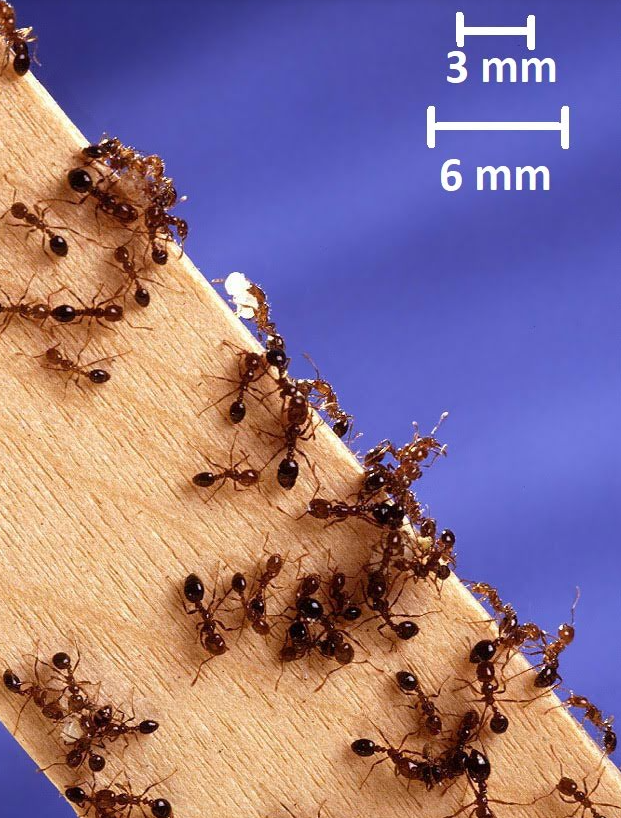
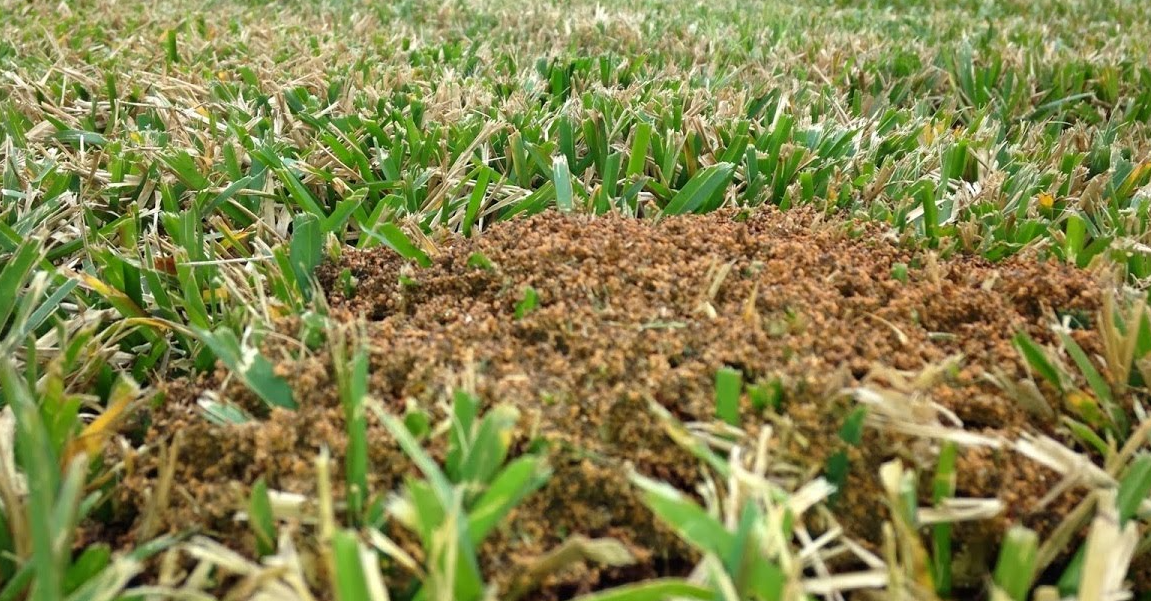
Red Imported Fire Ants were introduced to the United States sometime in the 1930's aboard a cargo ship in Mobile, Alabama. There are many species of fire ants, but the Red Imported Fire Ant is the most troublesome species. Fire ants are the only ants in College Station, Bryan and other Texas areas that have different sizes of workers. That makes them easier to identify! Fire ants are most commonly spotted when they build their dirt mounds in areas of your yard. The founding queens often prefer areas of transitioning habitat, so mounds are more common next to driveways and planting beds. Workers are black and red and range in size from 1/16th to 1/4 inch. They are similar in coloration to Carpenter Ants, but much smaller
Fire ants, Solenopsis invicta, are in the Order Hymenoptera and the Family Formicidae. They originate from Central and South America and are now found in all the Southern United States. They’ve also been introduced recently to Australia.
Life Cycle
Fire ants have a reproductive swarm (Queens and Kings with wings leave the colony) several times a year. This happens in a coordinated fashion over a large area, usually after a rain. The winged ants are attracted to transitional looking areas, so they often end up in backyard pools and driveways. The swarm lasts a day or two and nothing can be done to stop the ants from flying in. Swarming Kings and Queens are about the same size, shape, and color of worker Carpenter Ants, and can be confused with them after they clip their wings.
After a new colony is founded, the queen will lay both fertile eggs and trophic eggs. The trophic eggs are used as food for the developing colony. The fertile eggs hatch into white, legless larvae which grow larger with successive molts. After about 2 weeks, they molt into pupae. After an additional 2 weeks, they emerge from the pupae as adults. New colonies don’t start sending foraging ants outside the nest for about 6 weeks after the colony is founded. Within 6 months of founding, a colony will contain several thousand ants. On average, mature colonies have around 80,000 ants.
The life expectancy for a worker fire ant varies depending on what size it is. The smaller workers live 30 to 60 days, while the largest workers live 90 to 180 days. Queens live 2 to 6 years. All the workers are sterile females. The only males in a colony are those produced just before a swarm. The males die soon after the mating flight.
Why are they Pests?
Fire ants are predators and feed mainly on other insects, which does make them somewhat beneficial. However, they are not discriminate about what they sting, which mean people are often stung when they disturb mounds outside. When disturbed fire ants pour out aggressively. String can be slightly painful and leaves an itchy bump that looks like a pimple.
While they aren’t common indoor invaders, they will also scavenge for sweet, oily, or high protein foods, depending on the colony needs. During the hottest part of the summer, they start feeding on oily foods instead of protein. We occasionally find foraging on body oils left behind on sheets and dirty laundry. Yuck!
Fire Ant Control
Fire ant control is an ongoing process. It is not very hard to kill individual mounds, but new colonies move back in very quickly.
Fire ants next to your house are controlled with our Basic Quarterly Service. To control fire ants in the yard, we offer a biannual Fire Ant Service. We treat once in the spring and once in the fall – with additional spot treatments as needed during the summer.
Our primary method of controlling fire ants is a naturally occurring – and very powerful – insecticide called abamectin, which we use as part of a very effective fire ant bait. Fire ants LOVE our bait and once applied it will kill the entire colony, including the queen. This method also allows us to reduce the cost of our service by using the absolute minimal amount of insecticide possible. In fact, our bait reduces insecticide use by 90% – we only use one ounce of abamectin per acre.
Your yard will be recolonized by harmless, native ants – which will prevent fire ants from returning
For fire ant bait.. If there isn't more than 10% of the area in standing water or rain coming within 4 hrs of treatment, then we treat.